Bamiyan Panorama

Bamiyan Panorama

Friday, February 14, 2020

Gabarone - the city where cyclists are unwelcome


The city where cyclists are unwelcome
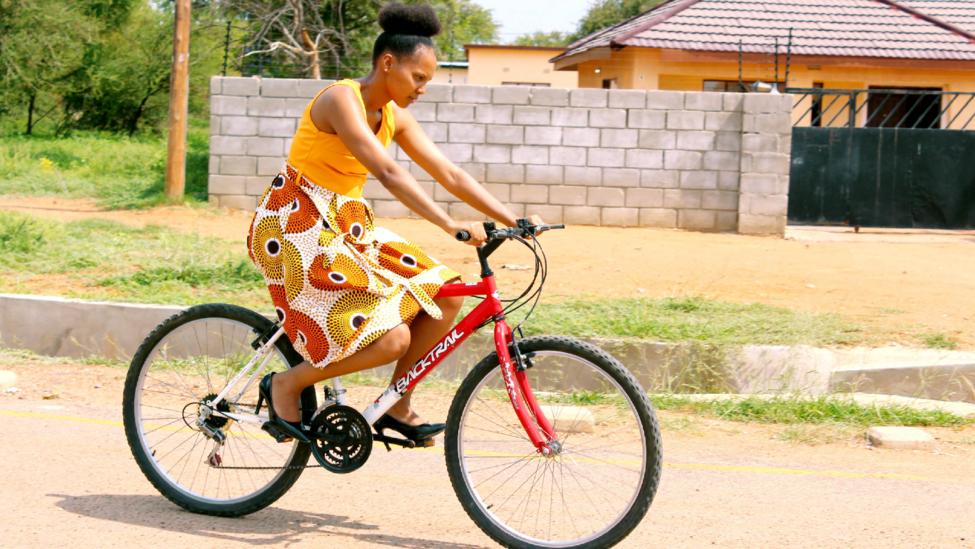

“I will hit you with this car,” Mpaphi Ndubo remembers a driver of an open white truck screaming at him. Ndubo was cycling safely on the opposite side of the tarmac, but it was the kind of abuse he was used to. “You should not be on the road,” the driver’s passengers in the back had added to the onslaught.
It is just one example of the many threats that cyclists have to deal with on the streets of Gaborone, Botswana’s capital city. Just because motor vehicle drivers pay road tax, they think they own the road, says Ndubo, a bicycle entrepreneur who has resolutely been cycling the streets of Gaborone for 22 years.
“Honestly, they have made streets seem more dangerous than lions,” he says.
The hostile attitude of local drivers towards cyclists emanates from a deep-seated belief that cycling is for the poor. In modern Botswana, drivers have enjoyed the respect that comes with owning a car as opposed to a bicycle, which is now considered archaic.  

But this preference for motor vehicles has brought problems with it. The number of cars registered in Botswana has doubled over the past decade. Two-thirds of these were listed in Gaborone, and the majority were second-hand imports. Many imported vehicles to the region do not meet emissions standards in their countries of origin and are not properly maintained or checked for their emissions.

“The state of air pollution in Gaborone is worrisome. The city is growing, and urban migration means more cars,” says Wiston Modise, a physicist researching air pollution at the University of Botswana. “High traffic congestion can result in high levels of pollutants such as carbon monoxide, nitrogen oxides, lead and hydrocarbons that pose major threats to human health, especially in the morning and afternoons during peak hours. City dwellers could suffer from respiratory diseases.”  
The result is that the burgeoning number of low-efficiency cars contribute considerably to air pollution in Gaborone, which is regularly ranked among the worst for air quality in the world.
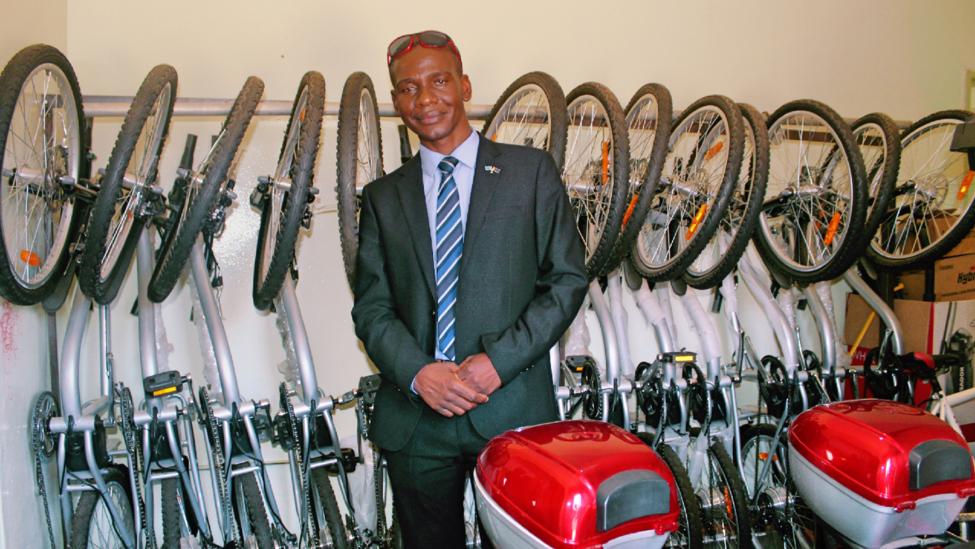
Mpaphi Ndubo has dealt with hostility against cyclists in Gaborone for 22 years (Credit: Sharon Tshipa)

For Mpaphi Ndubo, the answer was simple: encourage cycling in the city as an affordable, flexible and emissions-free method of transport. He wants Botswana to fall back in love with cycling.
Ndubo grew up a village called Masukwane in the north of Botswana, at a time when cycling was still held in high esteem. “When I was young my father bought a bicycle which my mother used to carry us children to the clinic,” he recalls. His mother would carry the youngest on her back, while either Ndubo or his older brother occupied the back carrier or crossbar.
At another village in northern Botswana called Sinete the role of the bike in the country’s past is celebrated in the form of a competition dubbed Dengenzela Bicycle Race. In this annual contest, elderly women race while simultaneously carrying a bucket of water on their heads, a mock baby on their backs and 25 litres of water on the back carriers of their bicycles. These cumbersome burdens – something that would never be seen at the hyper-efficient bike races of Europe – are intended to mimic the way bicycles were once commonly used in Botswana.
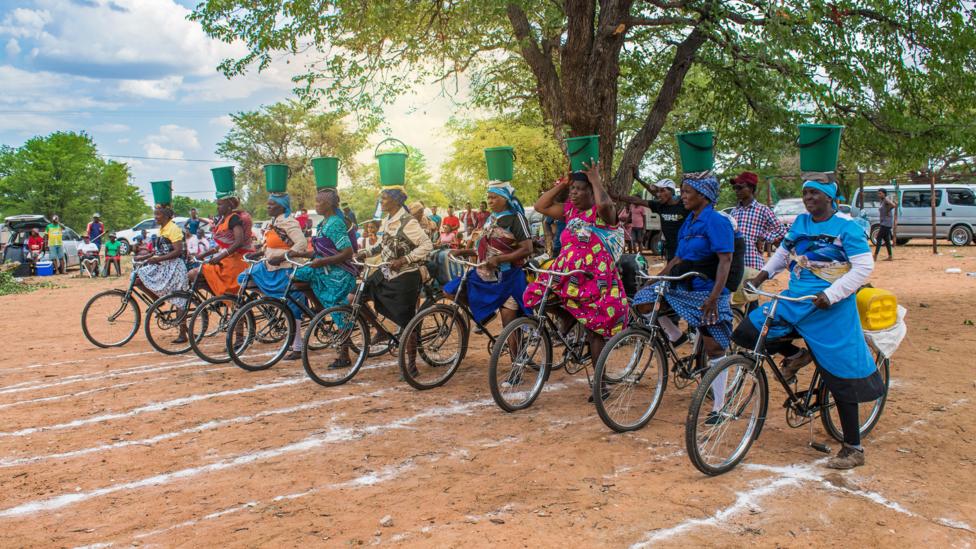
The Dengenzela Bicycle Race takes place every year in the village of Sinete, celebrating the role that cycling has played in local culture (Credit: Kenneth Middleton)

But this celebratory attitude towards bicycles in Sinete is not shared in the rest of Botswana. As soon as his business, AYS Cycling Solutions, had sprouted, Ndubo realised just how deep-rooted societal prestige around cars really was in Gaborone.
“My concept was welcomed by retailers. I was going to distribute to them, but they later turned their backs on me,” says Ndubo. Distributing bicycles for everyday transport wasn’t seen as a sound business plan, as bike shops tended to be viewed as niche outlets for those interested in cycling as a competitive sport, not for everyday travel. So, for his plan to go ahead, Ndubo had to become a retailer himself. “Generally people liked the products, but did not actually buy. I can’t help but think that my business came too early. Though cycling is leading in the first world, we are still decades behind development here.”
It was a discouraging start. Ndubo was stuck with a large fleet of bicycles that only a few people were buying. He did not give up, but instead started a non-governmental organisation called Cycling Embassy Botswana. Through it, he educates locals about the health and environmental benefits of cycling, and offers cycling tutorials to help people learn to ride. He is also became Gaborone city’s bicycle mayor, supported by BYCS, an Amsterdam-based social enterprise encouraging cycling in cities worldwide. 
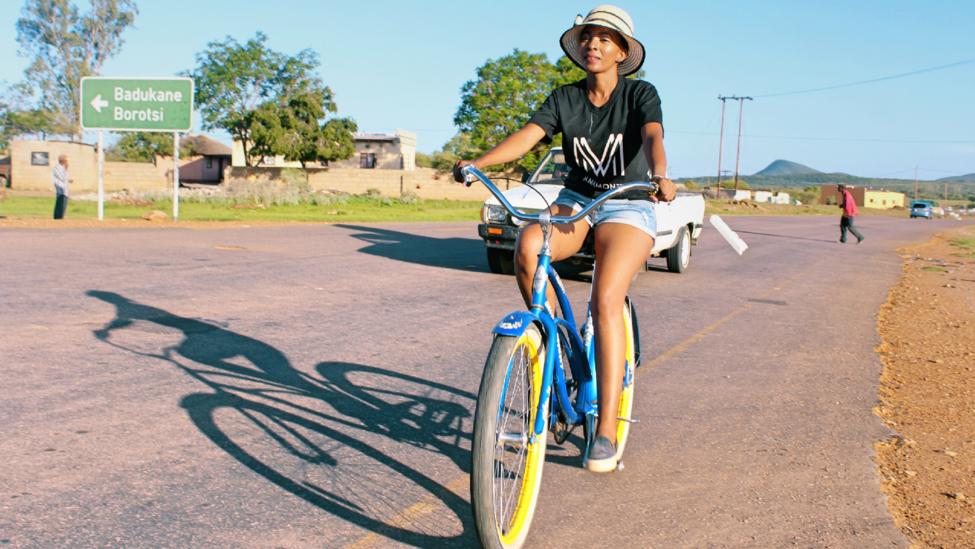
Young people, university students and government officials are among the people beginning to take up cycling day-to-day in Gaborone (Credit: Sharon Tshipa)

The European Union’s ambassador to Botswana Jan Sadek is working to encourage cycling in Gaborone too. “Dialogue on pollution and climate change inspired me to promote cycling in Botswana as a mode of transportation,” says Sadek, who is trying to cycle to and from work during his appointment in Botswana. For him, this is not a challenging commitment as he has been cycling since he was seven years old. When he came to Botswana in 2018, he brought his old bicycle that he has ridden in Sweden, the Czech Republic, Moscow, Russia, Belarus, Stockholm and Sudan. As Ambassador to Sweden in Sudan, he also cycled to and from work.
“Many people in Gaborone appreciate seeing me on the streets, but some want me off,” Sadek says. “Especially taxi drivers – they are annoyed by my presence on the road.” An upside for him are the groups of fascinated people who wave and greet him, as it is unusual to see leaders opt for an “undignified” means of transport. To date, Sadek says he personally knows of two other people he has inspired to take up regular cycling, and many others have expressed an interest.

Slowly, attitudes in Gaborone are changing. “Cycling is a perfect solution to air pollution in Gaborone,” says Opha Pauline Dube, a leading environmental change scientist at the University of Botswana and a resident of Gaborone. “We need to reduce our air pollution so there is no person who finds themselves exposed to levels that are higher than what is stipulated by the World Health Organization (WHO),” she says.
Botswana’s air pollution levels often rise higher than the WHO’s guidelines for particulate matter, ozone, nitrogen dioxide and sulphur dioxide. As well as emissions from vehicles, Botswana struggles with air pollution from industrial and indoor heating as many people continue to rely on traditional fuels for heating and cooking.
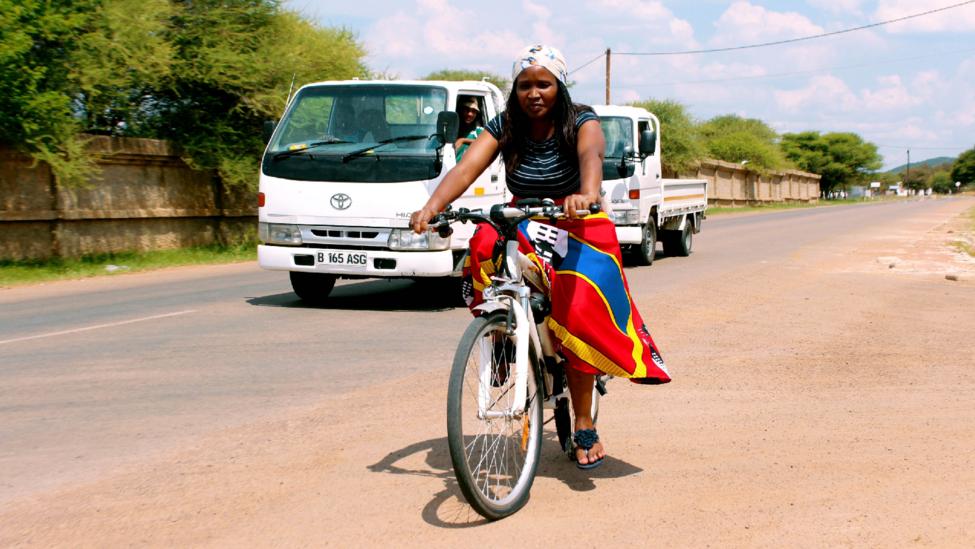

A cultural shift towards cycling in Gaborone has been slow, but entrepreneurs like Ndubo and Sadek hope it will continue (Credit: Sharon Tshipa)

But perhaps the biggest hurdle standing in the way of cycling returning as a popular mode of transport is the lack of proper infrastructure – good bicycle lanes, showers at workplaces, and clothing-changing facilities, among others. Without these people’s attitudes towards cycling will not change, says Dube. She recently received a bicycle as a gift, but has not yet learned to ride it. “Both my parents were cyclists, but they stopped cycling once they acquired cars,” she says. “So the bicycle disappeared in the home.” Regardless of the disadvantage, she intends to overcome her fear of falling and learn how to ride.
Ndubo’s Cycling Embassy Botswana lobbies for the provision of the infrastructure and policy changes that would make cycling safer in the city, seeking to contribute to the broader achievement of the UN’s Sustainable Development Goals. “When I started this business, I also wanted to address the problem of traffic congestion in our city,” says Ndubo. “But as time went by, I strove to contribute to the fight against climate change because bicycles are eco-friendly.”
Though still small, Ndubo now takes pleasure in his promising customer base of university students and government officials. His network of cycling lovers, though they are not full-time cycling lovers, he says is also expanding. Right now he has two electric bicycles that people rent out regularly at a shop in Molapo Crossing Mall in Gaborone.
With time, Ndubo aims to erode the social stigma around cycling in Gaborone. He hopes that one day the residents of the capital city might see the bicycle with the same appreciation and respect that the local people of Sinete view the elderly women racing through the village towards the finish line. And if Gaborone does become the next city to rediscover its love of the bicycle, it could enjoy much cleaner air as a result.

Friday, August 16, 2019

Dear China, Guess what?

You need to calm down.

You do not own the Uyghurs.  The Uyghurs have absolutely no reason to learn Mandarin.  Stop forcing the Uyghurs to learn Mandarin (a foreign language).

You do not own the residents of Taiwan.  They want to be left alone.  Leave them alone.  Stop imposing Mandarin (a foreign language) on them.

You do not own the residents of Hong Kong.  They want to be left alone.  Leave them alone.  Stop imposing Mandarin (a foreign language) on them.

Dear Chinese people living outside of China.  Guess what?  You can't violently attack people who have a different opinion than you.  If you want to act that way, go back to China and join the regime.  Then you can be free to violently attack whomever you wish to.

Sincerely,

Someone with the freedom to have their own opinion and the freedom to share it.

Monday, February 11, 2019

Ukraine official charged over acid killing

Ukrainian prosecutors have charged a high-ranking local official over a deadly acid attack on a prominent anti-corruption activist.
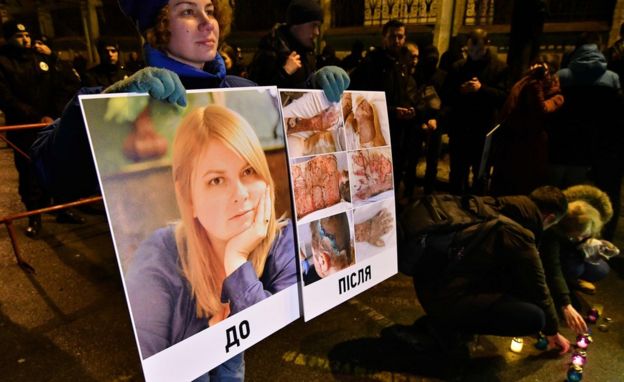
The agony of Kateryna Handzyuk, 33, shocked Ukraine. She died from her burns in November, after more than 10 operations. She was attacked in July.
Vladyslav Manger, head of the Kherson regional council in southern Ukraine, was charged with organising murder.
His lawyer said no evidence had been presented against his client.
Five other suspects are in detention.
Larisa Sargan, spokeswoman for Ukraine's chief prosecutor, said Mr Manger would have to appear before a judge in Kiev on Tuesday to face a detention order.
The indictment accuses Mr Manger of ordering the murder because of "personal hostility towards her for opposing illegal logging" in the region. A guilty verdict could send him to prison for life.
Activists mourn Handzyuk in Kiev, 4 Feb 19Image copyrightAFP
Image captionThe horrific attack triggered an outpouring of grief for Handzyuk
Investigators went to search Mr Manger's home on Monday. His lawyer, Dmitry Ilchenko, said "the prosecution has presented no evidence" for the accusation.
Mr Manger denied knowing Handzyuk personally or having any ties, telling a TV station he was "ready to answer all questions from investigators" and that he was "not going to go anywhere and will fully co-operate with the investigation".
Two other suspects - Sergei Torbin and Nikita Grabchuk - are in pre-trial detention in the case, and three more suspects are under house arrest.
Human rights activists say there were more than 50 assaults on anti-corruption campaigners in Ukraine last year, including five murders.

Thursday, February 07, 2019

Pashtun Tahaffuz (Protection) Movement - A protest Pakistan wants to hide from the world

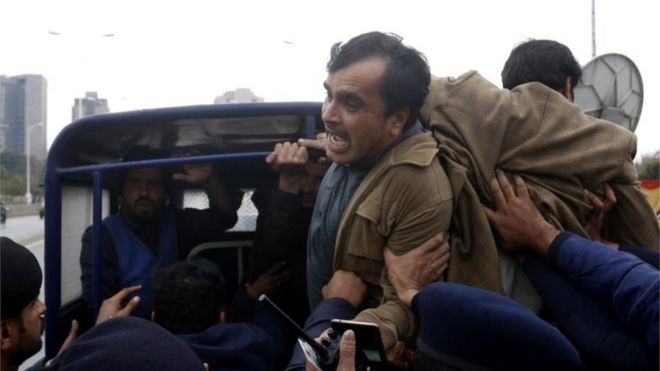
Security officials arrest supporters of Pashtun Tahaffuz Movement (PTM) during a protest in Islamabad, Pakistan, 05 February 2019.Image copyrightEPA
Image captionMore than 30 PTM supporters were arrested and their Islamabad rally did not take place
Why do some protests get reported in Pakistan and others not? M Ilyas Khan examines a story of human rights abuses the media is reluctant to cover and the authorities do not want to be told.
Pakistan's vibrant, at times almost cacophonic media, is struggling to report a fundamental contradiction in state policy.
This was at its most visible this week outside Islamabad's National Press Club.
An open ground outside the club premises - which some call Pakistan's Hyde Park because it is used for gatherings and protests - was occupied by a few hundred students from religious seminaries linked to a banned militant group.
They were holding an event to mark Kashmir Day, an official holiday in Pakistan which is observed to highlight human rights violations by Indian security forces in Indian-administered Kashmir.
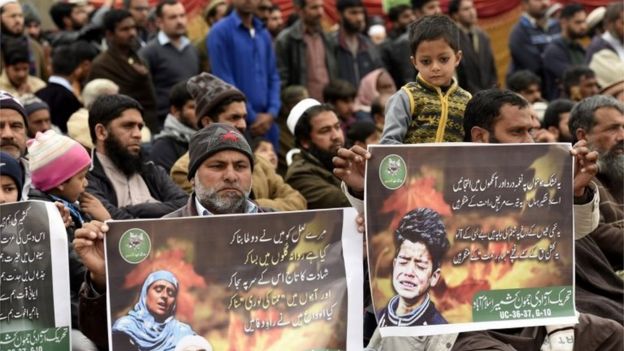
People listen to a speaker during a protest to show solidarity with Kashmiris living in Indian-administered part, on Kashmir Solidarity Day, in Islamabad, Pakistan, 05 February 2019.Image copyrightEPA
Image captionThe Kashmir rally was given lots of prominence and went ahead
But on the periphery of the Kashmir rally, police were busy spotting and arresting young men they suspected had come to attend another rally due to be held at the same venue.
Far from being militants, they were members or supporters of a rights movement that has been highlighting abuses by Pakistan's own military, in the ethnic Pashtun regions along the border with Afghanistan.
By the end of Tuesday, more than 30 activists of the Pashtun Tahaffuz (Protection) Movement, or PTM, had been rounded up, thrown in a police truck and taken to a police station.
The drama unfolded against the backdrop of speeches from the Kashmir rally in which speakers listed rights violations in Kashmir by the Indian army, and right in front of the eyes of the waiting media.
Dozens of television and newspaper photographers raced from one end to another trying to capture each arrest on camera.
But it was just their journalistic instincts kicking in - not a race to be first to actually cover the drama.
Because, while their TV channels thoroughly covered Kashmir Day events all over the country, including Islamabad, none of the videos of the arrests of the activists made it to the TV screens. Nor did they make headlines in the morning newspapers.
The six tribal districts of Pakistan - collectively called the Federally Administered Tribal Areas (Fata), and turned into a vast sanctuary for Taliban fighters fleeing the US invasion of Afghanistan after the 9/11 attacks - have been likened to an information black hole.
Many say the Talibanisation of these districts was allowed by the Pakistani establishment under a policy which sought to control Afghanistan with a view to prevent it from emerging as a strong regional ally of India, Pakistan's arch-rival.
Subsequent factionalisation of the Taliban drew the Pakistani military into tribal rivalries, triggering large-scale rights violations both by the military and the Taliban.
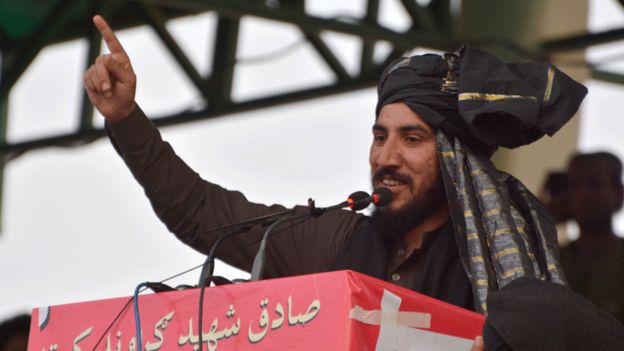
Quetta, Pakistan. 11th March, 2018. Chief of Pashtun Tahafuz Movement Mr Manzoor Pashteen addressing to Public gathering in Quetta, during campaign of Pashtun Long march in Pakistan.Image copyrightALAMY
Image captionManzoor Pashteen has accused the military of covering up years of rights abuses
The number of civilians killed in the conflict runs into thousands, and about three million people have been displaced, many of them many times.
For years, the local population caught in the conflict were too afraid to speak about transgressions, until the PTM burst onto the scene last February and started to circulate well-documented cases of abuses by the military and the Taliban, as well as the nature of the relationship between the two.
The material, the PTM's peaceful tactics and its insistence that the authorities treat people in the tribal areas in accordance with the law, as elsewhere in the country, caught the imagination of the media, and progressive elements across all ethnic groups hailed it as a good omen for the country's quest for democracy.
But then in the second half of 2018 the media came under increasing pressure, reportedly from the military, to stop covering the PTM. One by one, columnists offering analysis of the movement's message and its activities were dropped - not only by the marginal press but some of the most respected newspapers of the country.
Supporters of Pashtun Tahaffuz Movement (PTM) shout slogans during a protest against the arrest of one of their leader Alamzeb Mehsud in Karachi, Pakistan, 23 January 2019.Image copyrightEPA
Image captionPTM supporters have been demonstrating but the story is not making headlines
And any mention of the PTM completely vanished from the television screens.
More recently, the authorities have gone a step further and have begun breaking up PTM gatherings, confident in their knowledge that it is not going to get play in the media.
Over the weekend, police in Balochistan province cracked down on one such PTM gathering in which a prominent activist, Ibrahim Arman Luni, was killed.
Tuesday's gatherings were called by PTM chief Manzoor Pashteen in protest at Mr Luni's killing.

Wednesday, December 26, 2018

Why isn’t the Saudi government respecting our justice system?

"A Saudi national accused of fatally running over a 15-year-old Oregon girl may have fled the US on a private jet with his homeland’s help, according to a new report.
Abdulrahman Sameer Noorah, a former student at Portland Community College, was charged in the fatal hit-and-run death of Fallon Smart in 2016 — but vanished two weeks before his June 2017 trial, The Oregonian reported.
That day, a black SUV had driven the then-21-year-old Noorah to a yard two miles away where he broke off his ankle monitor, the paper reported.
Law enforcement officials believe the Saudi government issued Noorah a new passport, probably under a different name, and that he likely fled on a private plane, according to the report published Sunday.
US officials learned only recently from the Saudi government that Noorah landed home 18 months ago. But the Saudis haven’t answered US questions about how he got home or any additional details about him.
“We’re going to do everything we can to get him back,” Eric Wahlstrom, a supervisory deputy US marshal in Oregon, told the paper.
The day of the hit-and-run, Noorah’s gold Lexus illegally swerved around traffic that had stopped for Smart, who was crossing a street, and struck her at 55 to 60 mph, police said.
The high school sophomore, who was just weeks shy of her 16th birthday, died at the scene.
Noorah had 17 parking violations and a suspended license for driving uninsured at the time of his arrest.
Prosecutors still hope to try Noorah for the manslaughter, felony hit-and-run and reckless driving charges in the girl’s death — but the US and Saudi Arabia have no extradition treaty.
The girl’s family lawyer said news that the Saudis may have helped Noorah escape prosecution is “trauma on top of trauma.”
“It begs the question: Why isn’t the Saudi government respecting our justice system?” said Chris Larsen, a lawyer for Smart’s mother, Fawn Lengvenis.
“It’s reprehensible.”