Bamiyan Panorama

Bamiyan Panorama
Showing posts with label acid attack. Show all posts

Monday, February 11, 2019

Ukraine official charged over acid killing

Ukrainian prosecutors have charged a high-ranking local official over a deadly acid attack on a prominent anti-corruption activist.
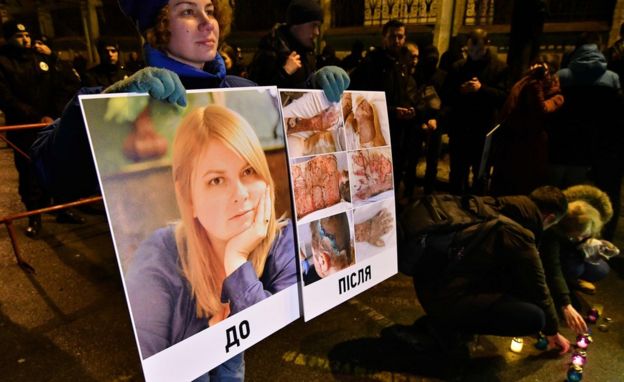
The agony of Kateryna Handzyuk, 33, shocked Ukraine. She died from her burns in November, after more than 10 operations. She was attacked in July.
Vladyslav Manger, head of the Kherson regional council in southern Ukraine, was charged with organising murder.
His lawyer said no evidence had been presented against his client.
Five other suspects are in detention.
Larisa Sargan, spokeswoman for Ukraine's chief prosecutor, said Mr Manger would have to appear before a judge in Kiev on Tuesday to face a detention order.
The indictment accuses Mr Manger of ordering the murder because of "personal hostility towards her for opposing illegal logging" in the region. A guilty verdict could send him to prison for life.
Activists mourn Handzyuk in Kiev, 4 Feb 19Image copyrightAFP
Image captionThe horrific attack triggered an outpouring of grief for Handzyuk
Investigators went to search Mr Manger's home on Monday. His lawyer, Dmitry Ilchenko, said "the prosecution has presented no evidence" for the accusation.
Mr Manger denied knowing Handzyuk personally or having any ties, telling a TV station he was "ready to answer all questions from investigators" and that he was "not going to go anywhere and will fully co-operate with the investigation".
Two other suspects - Sergei Torbin and Nikita Grabchuk - are in pre-trial detention in the case, and three more suspects are under house arrest.
Human rights activists say there were more than 50 assaults on anti-corruption campaigners in Ukraine last year, including five murders.

Tuesday, September 02, 2014

Acid victims' photo shoot draws attention in India

Acid victims' photo shoot draws attention in India

 
NEW DELHI — A fashion photo shoot featuring five victims of acid attacks is drawing wide attention in India. While the country keeps no official statistics on acid attacks, there are regular reports in the media of attackers targeting victims to disfigure or blind them, often because of spurned sexual advances.
The 41 photos show 22-year-old Rupa and four friends laughing and striking playful poses while wearing some of her fashion designs.
"I told them to be natural. I didn't do any makeup or editing. I told them, you look beautiful and you have to be the way you are," said the photographer, Rahul Saharan, who volunteers with the Stop Acid Attacks charity and is working on a documentary about acid victims. "They are very confident, so it was not too hard for me."
The photos have been shared widely since being posted Aug. 8 on the Facebook page run by the group, and have also been picked up by TV stations and newspapers.
The joy and confidence the five women display defy the horrific stories they tell.

n this Aug. 4, 2014 photo provided by Rahul Saharan, Indian acid attack victims Rupa, left, and Ritu pose during a fashion photo shoot in New Delhi, India.
In this Aug. 4, 2014 photo provided by Rahul Saharan, Indian acid attack victims Rupa, left, and Ritu pose during a fashion photo shoot in New Delhi, India.
 
 
Rupa's face was doused with acid when she was 15 years old by a stepmother unwilling to pay her marriage expenses. The wedding was called off. The photo shoot has brought in funding that will enable her dream of opening a boutique to come true.
Laxmi, now 22, was also 15 when she was attacked by her brother's 32-year-old friend after she refused his marriage proposal. Earlier this year, U.S. first lady Michelle Obama presented her with the International Women of Courage Award for campaigning against such attacks.
Ritu, 22, was attacked by her cousin during a property dispute. Sisters Sonam, 22, and Chanchal, 17, were asleep when acid was poured over them by a group of men who had been harassing them in their village in the northern state of Uttar Pradesh.
In all five cases, the girls' attackers were convicted, though such crimes in India often go unpunished.
Some 1,500 acid attacks are reported worldwide every year, according to the London-based group Acid Survivors Trust International, though it says the actual number is likely higher. India passed a law last year severely limiting sales of acid, but Stop Acid Attacks said it has since counted at least 200 attacks.
In this Aug. 4, 2014 photo provided by Rahul Saharan, Indian acid attack victim Ritu poses during a fashion photo shoot in New Delhi, India.AP Photo: Rahul Saharan
In this Aug. 4, 2014 photo provided by Rahul Saharan, Indian acid attack victim Ritu poses during a fashion photo shoot in New Delhi, India.
 

Monday, October 14, 2013

India abuse: 'I reported my acid attack husband'


India abuse: 'I reported my acid attack husband'


Almost one year on from the brutal rape of a young female student in Delhi, there are signs that more Indian women are finding the courage to report sexual violence. But many still live in fear, either of strangers - or of the man closest to them.
Reshma has five daughters and is pregnant for the sixth time - against her wishes. Her voice trembles constantly as she tells her harrowing story.
"I kept quiet for many years," she says.
"My husband treated me very badly because I had only given him daughters. Getting beaten up mercilessly became a routine for me. He wanted a son.
"When I got pregnant for the sixth time, he insisted I should get an abortion if it's another girl child. I refused and we had a big row.
"He threw acid on me, aiming at my vagina and abdomen."
Reshma breaks down as she recalls the attack. She has recently undergone an operation to try to repair some of the damage. Her baby is still alive, but she is extremely frail.

It took her four days to get medical help after the attack and that was only after her father arrived. She now lives with her poor parents in Kanpur, 500km (300 miles) outside Delhi.
They were aware of the terrible life that their daughter had with her husband, but were initially too afraid to think of police action against their own son-in-law.
Eventually, Reshma says, they stood by her.
The acid attack was the culmination of 15 years of violence at the hands of her husband. As she recovered, 35-year-old Reshma decided she did not want to be another female footnote in the death columns of the newspapers.
She registered a police case against her husband on five different grounds of cruelty. Now he is in prison awaiting trial. He denies all the charges.
Changing society The vicious assault on a young medical student on a Delhi bus last December sparked outrage across India and provoked national soul-searching about the extent of gender-based violence.
It also appears to have paved the way for more women to go to the police.
According to government statistics, 1,036 rapes were reported in Delhi in the year so far up to 15 August. That compares with 433 reports during the same period in 2012.
The same seems to hold true for areas outside the capital: in the small state of Jharkand, in eastern India, the number of reported rape cases rose from 460 in the first half of 2012 to 818 in the first half of 2013.
Despite this, as in many other countries, the conviction rate for rape remains low. According to the National Crime Record Bureau it stood at 24.1% in 2012, lower than the previous year.
Police say they are trying to improve the situation, including putting 400 more police vans on the streets of the capital. There has also been a push to recruit female police officers.
Avatar Sing Rawat, a Delhi police officer, says the force is also being trained in dealing with female victims. "The police are better sensitised now," he argues.
Ranjana Kumari, a well-known women's rights activist, says India has seen "structural changes" since the Delhi rape, but that streets can still be dangerous for women.
An Indian student demanding the death sentence for four men convicted of rape and murder of a student on a New Delhi bus - 13 Sept 2013 People across India called for the death sentence for the men convicted in the Delhi rape case
 
"Women are continuing to live their lives, coming out, working despite all the dangers.
But the most frustrating thing is that the state has still not been able to fix the accountability clearly when a crime is committed against women," she says.
"Political parties have made women's safety part of their political manifesto. When I travel to smaller cities I realise more conversations are happening around women's safety, but we need to make the system more accountable."
Walking around Delhi as night falls, it is clear that the streets are still empty of women.
Surabhi, a 25-year-old professional woman who travels to work by bus, says she does not think anything has changed since the outcry over the rape case.
"I don't want to change my lifestyle because of sexual attacks but, yes, I am scared - and I always carry a pepper spray in my bag.
"Men are very aggressive and they find excuses to touch you or feel you."
In Kanpur, Reshma is determined to see through her difficult decision to speak out.
"I don't want him to get out of prison. He made my life hell. I am very happy I took this stand," she says.
"I know speaking up will save many young girls in future. We are women and we also have a right to live life with dignity. I will take care of my daughters and myself."
She uses her scarf to wipe away tears. "Death comes only once. So why should we die every day at someone else's hands?"


Violence against women: The facts

Women graphic
India:
  • Rape within marriage is not considered a crime in India if the wife is over 15
  • Up to eight million female foetuses are thought have been aborted in India in the decade to 2011
  • In India, 22 women were killed each day in dowry-related murders in 2007
Sources: 2011 Census, National Crime Records Bureau, Amnesty International
Global:
  • More than one-third of all murders of women around the world are committed by a current or former partner
  • As many as 1 in 4 women experience physical and/or sexual violence during pregnancy
  • Violence by an intimate partner is the most common type of abuse, affecting 30% of women
Sources: World Health Organization, Women's Aid

Thursday, August 08, 2013

British women attacked with acid in Zanzibar

British women attacked with acid in Zanzibar


Two British women have had acid thrown in their faces in Zanzibar, police on the east African island say.

Katie Gee and Kirstie Trup, both 18 and from London, were working as volunteer teachers on the island.

In a statement, Kent-based i-to-i Travel said the women had now been released from hospital.

The Foreign Office said it was "concerned to hear of an attack on two British nationals" and was "providing consular assistance".

Police said two men on a moped threw the acid at the women, splashing their faces, chests and hands as they walked through the streets of Stone Town, the old part of the island's capital Zanzibar City, which is a Unesco world heritage site.

 Kirstie Trup and Katie Gee
Kirstie Trup (left) and Katie Gee are both from London


Deputy police commissioner Mkadam Khamis told AFP news agency: "The motive for the attack on the volunteers aged 18 years, has not been established. Investigations are on until we apprehend the criminals."

The two women were volunteers for the charity Art in Tanzania, having booked through the company i-to-i Travel.

Kari Korhonen runs Art in Tanzania with two other directors. He told the BBC in an email the "ladies are OK considering the seriousness of this type of case".

He added: "We have been operating as NGO some 10 years and this is the first serious incident."

He said he found out about the incident immediately after it took place and that the charity was "sorting out the incident background with the British High Commission and the Tanzanian-Zanzibar government".

Another of Art In Tanzania's representatives in Zanzibar said the two women had been volunteering with the organisation for just over two weeks. He said they had been on their way to dinner when they were attacked.

In a statement, i-to-i Travel said: "All our efforts remain focussed on ensuring they are supported whilst assisting them and their relatives with the arrangements for their return home."

It added that "the motive for the incident is as yet not known".

The women were in the final week of their trip, i-to-i Travel said.

The police on Zanzibar said it was the first time foreigners had been attacked in this way.

Map of Zanzibar

The BBC's Tulanana Bohela in Dar es Salaam says Islam is the main religion on Zanzibar and in more remote parts of the island, away from tourist beaches, there are signs asking foreigners to respect the local culture and cover up - in case skimpy outfits upset villagers.

However, most islanders depend on tourism for their livelihoods and are happy to see tourists and there is little antagonism towards them, she says.

Tanzania's minister of information, tourism, culture and sports, Said Ali Mbarouk, condemned the attack.

"We should co-operate with other government sectors to ensure that the perpetrators are arrested and brought to justice," he said.

"And I beg our nationals, this is not something they should be doing. Tourism is the strongest pillar of our economy, so if we do such acts we are killing our economy, and our livelihoods in general.

"So it is not an honourable thing to do, it's a bad thing and it should be condemned by all citizens of Zanzibar."

The Foreign Office's travel advice for the semi-autonomous Zanzibar is the same as that for the rest of Tanzania.

The Foreign Office says that while the majority of 75,000 British nationals have "trouble free" visits to Tanzania every year, "violent and armed crime is increasing" and "there is an underlying threat from terrorism".

It also says that "mugging, bag snatching (especially from passing cars) and robbery have increased throughout the country" and "in Zanzibar incidents have taken place in Stone Town and on popular tourist beaches".

Recent attacks in Zanzibar include an acid attack on a Muslim cleric in November, and the shooting dead of a Catholic priest in February. Another priest was shot and wounded in December.