Bamiyan Panorama

Bamiyan Panorama
Showing posts with label artist. Show all posts

Friday, January 08, 2016

Shamsia Hassani: ‘I want to colour over the bad memories of war’

Shamsia Hassani: ‘I want to colour over the bad memories of war’
Afghanistan’s cultural image is changing, thanks in part to the strong, graceful and dynamic female silhouettes emerging from this bold graffiti artist’s spray can
 Shamsia beside what's reckoned to be the first ever piece of 3D street art on Afghanistan. Photograph: Shamsia Hassani/www.kabulartproject.com
Wednesday 17 September 2014
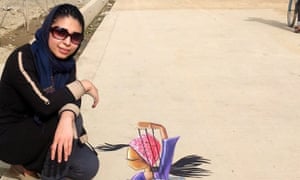
Shamsia beside what's reckoned to be the first ever piece of 3D street art on Afghanistan.
Shamsia beside what's reckoned to be the first ever piece of 3D street art on Afghanistan. Photograph: Shamsia Hassani/www.kabulartproject.com

Just over a decade ago, the abiding image of art in Afghanistan was theBuddhas of Bamiyan being destroyed by Taliban dynamite, but Shamsia Hassani is proof of how much has changed since. Hassani is the country’s foremost graffiti artist, and her work is respraying Afghanistan’s cultural image.
“I want to colour over the bad memories of war on the walls,” Hassani told Art Radar last year, “and if I colour over these bad memories, then I erase [war] from people’s minds. I want to make Afghanistan famous because of its art, not its war.”
Graffiti has proved the perfect artform for modern-day Afghanistan, practically as well as metaphorically. It is the ultimate democratic medium, freely available to spectators and artists alike (save for the spray-can budget) and capable of transmitting a powerful idea or message without words (Afghanistan still has one of the world’s lowest literacy rates). Art galleries are scarce in the ravaged cities, but there are blank walls and pavements in abundance. Hassani even sprayed one of her pieces on the ruins of Kabul’s Russian Cultural Centre. And where graffiti is an outlaw activity in the west, policed with Taliban-like vigilance, in Afghanistan, it is embraced (Hassani teaches at Kabul University’s faculty of fine arts). For extra irony, she took up the art after being inspired by British artist, Chu, who held a graffiti workshop in Kabul in 2010.
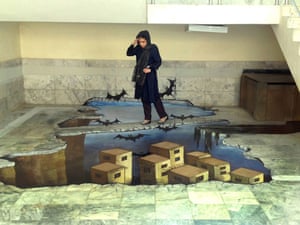
A 3D floor painting inside the French Cultural IUnstitute, Kabul.
A 3D-style floor painting inside the faculty of fine arts, Kabul University. Photograph: Shamsia Hassani

 A 3D-style floor painting inside the faculty of fine arts, Kabul University. Photograph: Shamsia Hassani
Not that Hassani doesn’t have problems. The security situation is still far from ideal. And being a female artist, she is not always greeted with enthusiasm when she’s out working. Some regard her as a vandal, others believe a proper Afghan woman’s place is in the home.
Women are very much Hassani’s subject matter. She often draws them in stylised blue silhouettes, wearing burqas, or, more recently in a hijab. They’re far from Taliban-sanctioned stereotypes, though. Hassani’s figures are active subjects: strong, graceful, dynamic, often depicted emerging from depths, lost in reflection, even dancing. “I want to show that women have returned to Afghan society with a new, stronger shape,” she told Art Radar. “It’s not the woman who stays at home. It’s a new woman. A woman who is full of energy, who wants to start again.”
• This article was amended on 18 September 2014 to clarify that the quotes from Shamsia Hassani came from an interview with the website Art Radar.


http://www.theguardian.com/artanddesign/2014/sep/17/shamia-hassani-i-want-to-colour-over-the-bad-memories-of-war


Tuesday, January 29, 2013

Afghan female artist beats the odds to create

Afghan artist Malina Suliman paints graffiti on a wall in Kandahar city
KABUL/KANDAHAR, Afghanistan (Reuters) - Charred bodies lie scattered against blood-stained walls and debris covers the ground. For Afghanistan, the only unusual thing in this gruesome scene is that the blood is red paint - and part of an art installation.
It's a work by 23-year-old Afghan artist Malina Suliman, who risks her life, sometimes working by flashlight after dark, to create art in southern Kandahar province, the birthplace of the Taliban and still one of the country's most dangerous areas.
Her pieces, which range from conceptual art to paintings and sculpture, are bold representations of the problems facing her generation and have drawn praise from top officials in Kandahar, making her exceptional in a place where women face even greater restrictions than in other parts of the country.
"Many people had never seen an art installation... Some were offended and others were hurt because they'd experienced it before," Suliman said of "War and Chaos," which was in an exhibit last year and depicts the aftermath of a suicide bombing, an all too common event in Kandahar.
Her haunting, powerful pieces earned her an invitation last year to President Hamid Karzai's palace in Kabul, where she showed her art to the Afghan leader, who is also from Kandahar.
Suliman's artwork is now making waves in the Afghan capital of Kabul, where she lived after fleeing the violence of her native province as a child. In December, she had two exhibits there, a highlight of which was a sculpture of a woman in baggy clothing with a noose tied around her neck.
An exhibit in Kandahar, where the Taliban and tribal elders dominate public opinion, was the first there in three decades. She drew a mostly male crowd of around 100, including Kandahar governor Tooryalai Wesa and some of Karzai's relatives.
"I was taken aback by her work. I had only seen great art abroad, but never here," Wesa later told Reuters, recalling the exhibit, which featured a painting of a foetus in the womb suspended from a tree and being pulled in different ways. "I hope it persuades more women to do the same."
Suliman said this piece, called "Today's Life", reflected the frustrations of her generation.
"Before a child is born, the parents are already thinking that a son can support them and a daughter can be married off to a wealthy suitor. They don't stop to think what the child may want," she said.

Afghan artist Malina Suliman paints graffiti on a wall in Kandahar city

SLOW PROGRESS FOR ART
Thirty years of war and conflict, starting with the Soviet invasion of 1979, effectively shelved Afghanistan's art scene. The austere 1996-2001 rule of the Taliban then banned most art outright, declaring it un-Islamic.
Since the Islamist group was toppled by U.S.-backed Afghan forces almost twelve years ago, large Afghan cities have resurrected something of an art movement, but progress is slow.
Herat city, in the country's west, now has art studios for rent, while Mazar-e-Sharif in the north has an artist collective and a lively graffiti scene.
Suliman, who is self-confident and energetic with almond-shaped eyes, joined the Kandahar Fine Art Association, a relatively new, all-male group whose goal is to support and exhibit local art, one year ago.
The small collective of 10 artists caught the eye of the Ministry of Information and Culture, which funded and last year opened Kandahar's first art gallery, where Suliman has exhibited. Since she joined the collective, several more Kandahar-based female artists have come on board.
But the stakes remain high.
"One of our biggest fears is that people will mistake us for creating art for foreigners or working with NGOs. People who work with NGOs get shot without question in Kandahar," she said.
Despite her success, Suliman has received threatening phonecalls warning her against attending her own exhibits, and the Taliban have spoken out against her.
Even creating her art must take place away from public view. She often waits until after dusk, working with a dim flashlight.
Suliman recalls her first exhibit in Kandahar last year, and how she trembled as she made her way towards the gallery, in fear of it being bombed.
"I was so scared... Whenever there is a gathering of government officials it becomes a target," she said.
But one of Suliman's greatest challenges lies at home.
"The night of my first exhibit my family told me 'if you go, don't come back'," she said with a wry laugh.
While her sisters and mother now support her ambition and passion, her brothers and property developer father remain fiercely opposed -- attitudes typical for Afghanistan.
She is now looking to expand Kandahar's budding art scene to nearby Helmand, hoping to secure locally-sourced funds for workshops and training.
When asked if she is scared, she mentions her sculpture of the hanged woman and smiles.
"That's what happens to women when they ask for their rights in this country," she says, impudently.

Afghan artist Malina Suliman is pictured inside The Venue art gallery in Kabul